Is Sports Arbitrage Betting Worth It?
A Professional Operator’s Perspective: Why Small Profits Can Become Significant Through Volume, Consistency and Execution.

When people first discover sports arbitrage betting, one of the most common questions is: Is it really worth it?
At first glance, the numbers may not seem particularly attractive.
Imagine investing $5,000 across different bookmakers to execute an arbitrage opportunity that generates a theoretical profit of just 2%.
That’s $100 in potential profit.
For someone unfamiliar with this strategy, committing $5,000 to earn $100 may seem like a poor return on the capital involved.
And that’s exactly where many beginners misunderstand how professional arbitrage betting works.
Professional arbitrage operators don’t necessarily focus on making a large profit from a single bet. They focus on executing multiple profitable opportunities consistently.
1. The Biggest Misconception About Sports Arbitrage
Traditional bettors often evaluate an opportunity based on how much they could win from a single event.
Sports arbitrage works differently.
Instead of predicting which team will win, an arbitrage operator identifies differences in the odds offered by bookmakers and attempts to cover every possible outcome of an event.
When the odds, stakes and settlement conditions align correctly, the combined positions can produce a positive theoretical return regardless of the sporting result.
However, the profit margin on an individual opportunity is often relatively small.
A 1%, 2% or 3% return might not sound impressive.
But evaluating sports arbitrage based on a single operation is like evaluating a business based on a single sale.
The real question isn’t necessarily how much one operation earns. It’s how much the operator can generate through a sustainable volume of correctly executed operations.
2. Professional Arbitrage Is About Volume
Let’s consider a practical example.
Suppose an arbitrage operator identifies an opportunity with the following characteristics:
One hundred dollars might not seem particularly significant compared to the capital required.
Now imagine that the operator has the experience, available balances, bookmaker access and execution capacity to complete 50 similar operations in a single day.
The numbers change considerably.
| Operations | Profit per Operation | Total Theoretical Profit |
|---|---|---|
| 1 | $100 | $100 |
| 10 | $100 | $1,000 |
| 25 | $100 | $2,500 |
| 50 | $100 | $5,000 |
Illustrative scenario only. This calculation assumes every operation produces the same theoretical profit and does not account for execution losses, transaction costs or other operational risks.
Suddenly, what initially appeared to be a small return becomes a significant amount.
Of course, real operations are not identical.
Some opportunities offer higher margins. Others offer lower margins. Some require smaller stakes, while others require more capital.
Not every opportunity can be executed successfully, and not every day offers the same volume.
Nevertheless, this example demonstrates one of the most important principles of professional sports arbitrage:
Small individual margins can become meaningful when combined with sufficient capital, operational efficiency and consistent execution.
3. Why Consistency Matters More Than a Single Big Win
One of the characteristics that makes sports arbitrage interesting is that its theoretical profitability does not depend on correctly predicting the winner of a match.
In traditional sports betting, even a well-researched prediction can lose.
In arbitrage betting, the objective is different.
The operator searches for price discrepancies between bookmakers that make it mathematically possible to distribute stakes across all relevant outcomes and calculate a positive return.
Instead of asking, “Which team will win?”, the operator asks:
Do these odds allow me to cover every possible outcome at a positive margin?
When a genuine arbitrage opportunity is identified and every required bet is accepted at the intended odds, under compatible settlement rules, the resulting payout can be structured to produce a profit regardless of the event’s outcome.
But there’s an important distinction: a mathematically profitable opportunity is not automatically a risk-free real-world operation.
Odds can change before all bets are placed. Bookmakers may reject stakes, impose limits, suspend markets or apply different settlement rules.
These execution risks must always be considered.
4. My Experience After Nearly Five Years of Professional Arbitrage
I’ve been operating sports arbitrage professionally for approximately five years.
During this period, I’ve learned that successful arbitrage is not simply about finding a positive percentage on a scanner.
It requires discipline, capital management, speed, attention to detail and a deep understanding of how bookmakers operate.
One of the most important lessons from my experience is that the accumulated result matters far more than the profit from an isolated opportunity.
Some operations produce excellent returns. Others generate relatively small profits.
But over time, those individual results contribute to the overall performance of the operation.
In my personal experience, I have never finished a month with an overall loss from my arbitrage operations.
Month after month, my results have remained positive.
This is one of the main reasons I consider sports arbitrage such a valuable strategy.
However, these are my personal historical results, not a guarantee that other operators will achieve the same performance.
Results depend on many factors, including available capital, bookmaker access, market conditions, operational experience and the ability to manage execution risks.
My experience demonstrates what has been possible within my own operation, not what every beginner should expect.
5. The Hidden Challenge: Capital and Liquidity
If sports arbitrage can generate positive theoretical returns, why doesn’t everyone do it?
Because finding an opportunity is only one part of the process.
Executing it efficiently is another.
Consider our earlier example of a $5,000 operation generating $100 in theoretical profit.
The operator needs sufficient funds distributed across the bookmakers involved.
- Both bookmakers must accept the required stakes.
- The odds must remain available during execution.
- The markets must follow compatible settlement rules.
- Sufficient liquidity must be available to complete the bets.
A scanner might identify a theoretically attractive opportunity, but the bookmaker may not accept the full amount needed to complete the arbitrage.
This means the theoretical profit displayed by a scanner may differ from what an operator can actually achieve.
Another challenge is capital turnover.
Professional operators often reuse available funds across multiple opportunities, but balances can become temporarily unavailable while bets remain unsettled.
Withdrawals, deposits, payment processing and account restrictions can also affect operational capacity.
Therefore, executing 50 operations in a day does not necessarily mean having 50 times the capital required for a single operation.
But it does require sufficient available liquidity, careful bankroll allocation and efficient capital management.
6. The Role of Arbitrage Scanners
Finding dozens of opportunities manually would be extremely time-consuming.
This is where specialized arbitrage scanners become valuable.
Platforms such as BetBurger compare odds across multiple bookmakers and identify potential arbitrage opportunities.
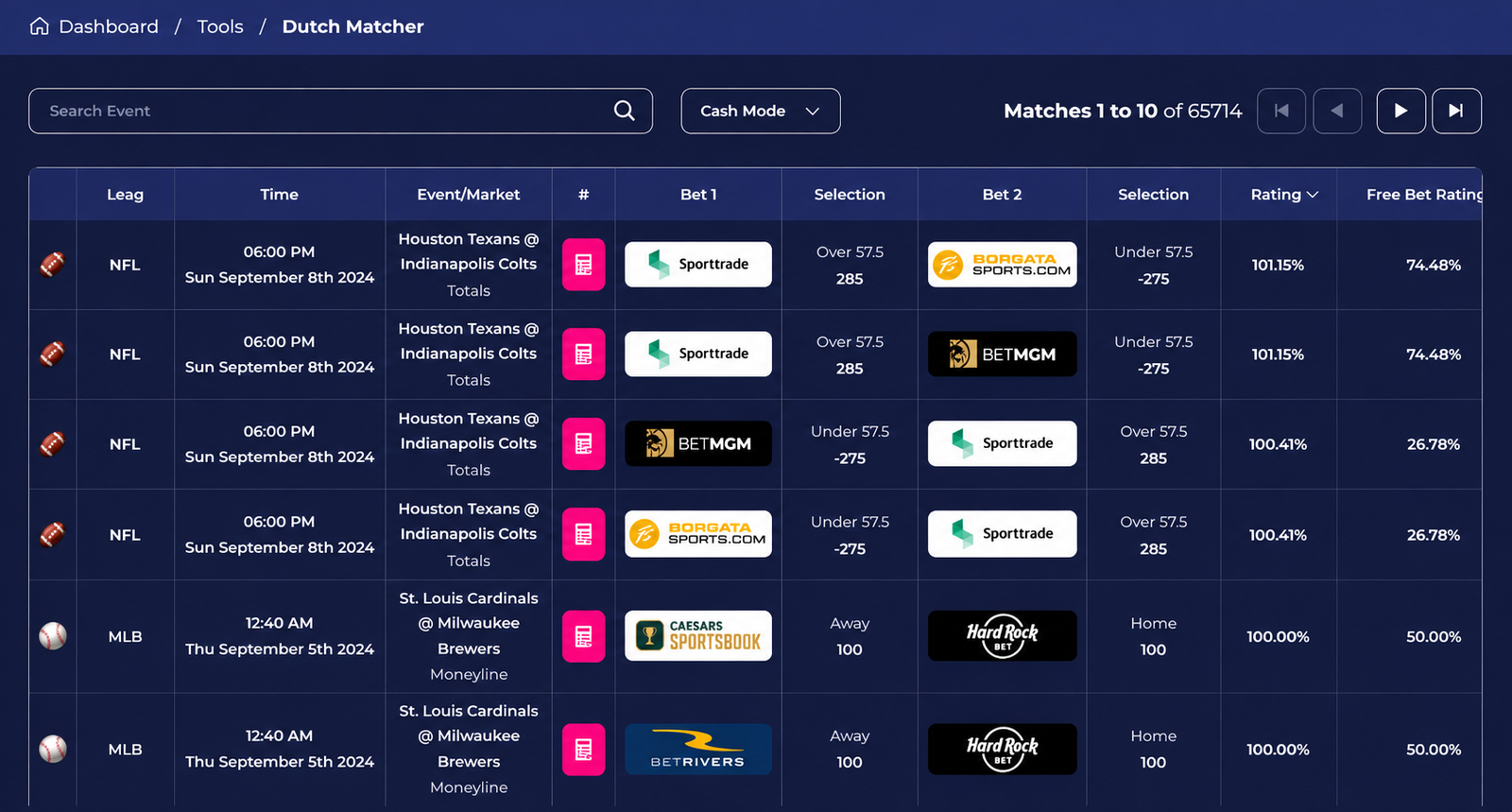
Arbitrage scanners can help operators:
- Monitor multiple bookmakers.
- Identify potential surebets in Prematch and Live markets.
- Filter opportunities by sport, market, bookmaker and profit percentage.
- Calculate stake distribution.
- Evaluate theoretical returns before execution.
These tools can significantly improve the efficiency of identifying opportunities.
However, a scanner is not an automatic guarantee of profitability.
The operator remains responsible for verifying the odds, understanding the markets, assessing liquidity and deciding whether an opportunity is suitable.
Technology helps identify possibilities. Experience and execution determine how those possibilities are managed.
7. So, Is Sports Arbitrage Really Worth It?
My answer is yes — sports arbitrage can be a valuable strategy for operators who understand its mechanics and have the resources to execute it properly.
But it’s important to understand what makes it viable.
It’s not necessarily the size of a single profit.
It’s the combination of multiple factors:
- The ability to identify genuine opportunities.
- Sufficient capital and available liquidity.
- Consistent operational volume.
- Accurate calculations and execution.
- Effective risk management.
- Access to suitable bookmakers and markets.
For a beginner with limited capital, the returns may initially seem modest, especially when considering the time, effort and risks involved.
For an experienced operator with an established process, the accumulation of many small margins can create a meaningful overall result.
Still, bookmaker restrictions, changing market conditions, transaction costs, errors and operational losses can reduce or eliminate profitability.
That’s why sports arbitrage should be approached as a serious financial activity rather than an easy way to make money.
Final Thoughts: Think Beyond a Single Operation
One of the biggest mistakes beginners make is looking at a $20, $50 or $100 arbitrage profit and immediately concluding that the strategy isn’t worthwhile.
Professional operators often look at the bigger picture.
They evaluate how efficiently capital can be deployed, how many suitable opportunities are available and what results can be achieved over an extended period.
After nearly five years working with sports arbitrage, I consider this long-term perspective one of the most important lessons I’ve learned.
The value of sports arbitrage is not necessarily found in one operation. It is found in the potential accumulation of many well-executed operations.
And that is what makes this strategy worth studying.
Want to Learn How to Find Surebets?
Explore BetBurger and discover how arbitrage scanners can help you identify opportunities, configure custom filters and calculate theoretical returns.
Explore BetBurger →Educational content only. This article reflects the author’s personal experience and includes illustrative calculations. Sports arbitrage involves execution, liquidity, bookmaker and regulatory risks. Theoretical profits and historical results do not guarantee future returns. Affiliate links may generate a commission at no additional cost to you.