Have you ever wondered how some bettors find opportunities to profit from a sporting event without having to predict which team will win? That’s the idea behind sports arbitrage betting, also known as surebetting. By comparing odds offered by different bookmakers, it’s possible to identify mathematical opportunities where carefully calculated bets cover every possible outcome of an event.
In this beginner-friendly guide, you’ll discover how sports arbitrage works, understand the mathematics behind it, explore practical examples, and learn how specialized tools can help you find opportunities more efficiently.
What Is Sports Arbitrage Betting?
Sports arbitrage, also known as surebetting, is a strategy that takes advantage of differences in odds between bookmakers. The concept is simple: find suitable odds, calculate the stakes and cover every possible outcome.
Different bookmakers may offer different prices for the same event. Certain combinations create a theoretical arbitrage opportunity.
How Does Sports Arbitrage Work?
Let’s use a hypothetical NBA game between the Los Angeles Lakers and the Boston Celtics to understand how the process works.
Either the Lakers or the Celtics will win the game, including overtime.
Each bookmaker may offer different odds for the same market.
When the combined implied probabilities are below 100%, a theoretical arbitrage opportunity exists.
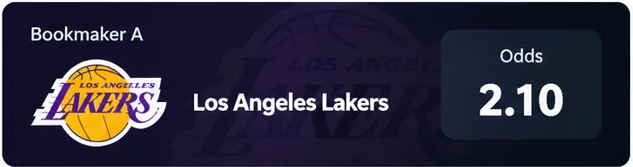
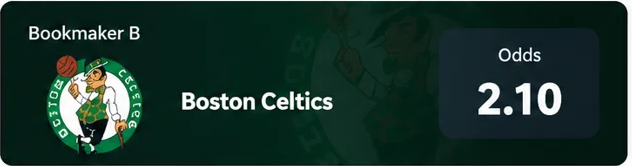
Important: Both bets include overtime. By covering both outcomes at these odds, you can secure a theoretical positive return regardless of the result, provided both bets are accepted at the stated odds and follow the same settlement rules.
Stake Calculation
Let’s assume a total stake of $1,000. The bets are distributed using a mathematical formula to ensure the same return in both outcomes.
| Outcome | Odds | Stake | Potential Return |
|---|---|---|---|
 Los Angeles Lakers
|
2.10 | $500.00 | $1,050.00 |
 Boston Celtics
|
2.10 | $500.00 | $1,050.00 |
Guaranteed Result
No matter which team wins, the total return will be $1,050.00.
With a total stake of $1,000.00, the profit is $50.00, which represents a 5% return.
Why Does This Work?
Both outcomes are covered at odds of 2.10. With $500 placed on each team , the winning bet returns $1,050. After subtracting the total $1,000 invested, the theoretical profit is $50, equivalent to a 5% return.
Sports Arbitrage with Different Odds
In the previous example, both bookmakers offered the same odds, so we could divide our $1,000 equally between the two outcomes. But what happens when the odds are different?
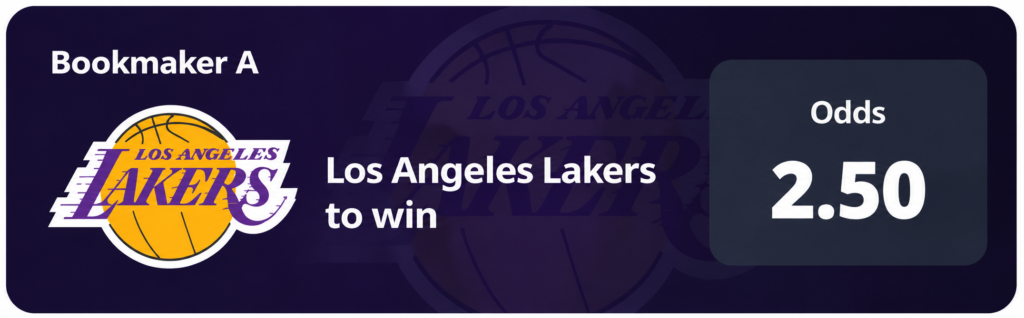
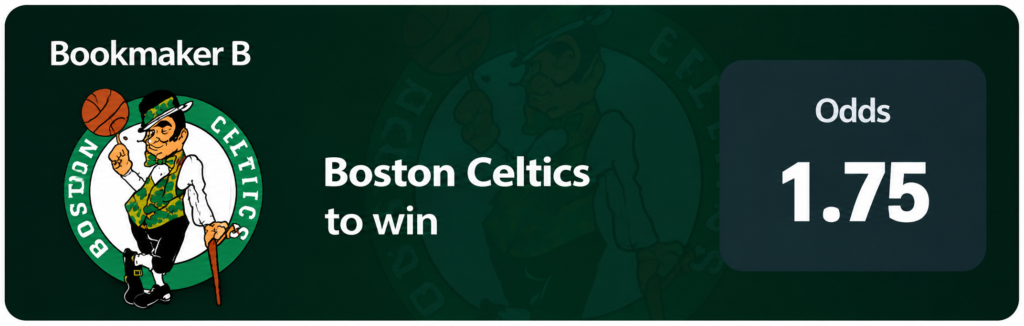
Why Do We Need Different Stake Amounts?
When the odds are different, we cannot simply split the money equally. The stake amounts must be mathematically adjusted to balance the potential payouts and aim for the same return in both outcomes.
Stake Distribution
To balance the returns, we calculate the stake amounts based on the odds offered by each bookmaker.
Total bankroll: $1,000.00
$411.76
(41.18%)
$588.24
(58.82%)
Comparing Both Outcomes
With these stake amounts, the total return is approximately the same regardless of which team wins.
Total Bankroll: $1,000.00
| Outcome | Stake | Odds | Total Return | Theoretical Profit |
|---|---|---|---|---|
|
Lakers Win
|
$411.76 | 2.50 | $1,029.40 | $29.40 |
|
Celtics Win
|
$588.24 | 1.75 | $1,029.42 | $29.42 |
Guaranteed Result
No matter which team wins, the total return will be approximately $1,029.41.
With a total stake of $1,000.00, the theoretical profit is $29.41, which represents a 2.94% return.
The small difference between the two returns ($1,029.40 and $1,029.42) is caused by rounding the stake amounts to two decimal places. In practice, the returns will be effectively the same.
Compare Odds
Compare the same event and betting market across different bookmakers.
✓ Best available odds:
Lakers 2.50 + Celtics 1.75
Check for Arbitrage
Calculate whether the combined implied probability is below 100%.
= 0.9714
Arbitrage Opportunity Found!
The combined implied probability is approximately 97.14%, indicating a theoretical profit margin.
Calculate Stakes
Distribute your bankroll to balance the potential returns.
Place Both Bets
Confirm the odds, market rules and stakes before placing both bets.
Both bets must be accepted at the intended odds and under compatible settlement rules.
Educational example: All odds are hypothetical. Actual returns depend on bet acceptance, market rules, fees and other operational factors.
You Don’t Need to Do These Calculations Manually!
BetBurger automatically identifies potential arbitrage opportunities, compares bookmaker odds, and calculates the stakes you need.
Live betting markets
Best available odds
Potential profit %
Automatic stake calculator
Review each opportunity and place your bets with the indicated bookmakers.
How to Find Sports
Arbitrage Opportunities
Understanding how sports arbitrage works is the first step. But once you know how to calculate a surebet, an important question arises:
How can you find these opportunities consistently without spending hours comparing odds?
There are two main ways to search for sports arbitrage opportunities: manually checking bookmakers or using specialized software such as BetBurger.
Manual Arbitrage Searching: Why Is It So Difficult?
Imagine trying to find a profitable arbitrage opportunity in an NBA game. You open one bookmaker, check the odds, visit another bookmaker, compare the markets, and calculate whether the available odds create an arbitrage opportunity.
If the numbers don’t work, you start again with another bookmaker or sporting event. Now imagine repeating this process across dozens of games, different sports, and betting markets. The problem isn’t understanding the mathematics. It’s the amount of work required to find opportunities.
Time-consuming research
Comparing odds across multiple bookmakers requires constant attention and repeated calculations.
Limited market coverage
A person can only check a relatively small number of events and markets at a time.
Constantly changing odds
By the time you finish comparing several bookmakers, the available prices may already be different.
Missed opportunities
While you’re analyzing one match, potential arbitrage opportunities may appear in other sports or markets.
Repetitive work
Searching manually involves repeating the same steps over and over again.
BetBurger: A Smarter Way to Find Sports Arbitrage Opportunities
Instead of manually opening multiple bookmaker websites and comparing odds one by one, imagine having a platform that performs much of this research automatically. That’s the purpose of BetBurger, a specialized sports arbitrage scanning platform.
BetBurger monitors odds from supported bookmakers and identifies potential arbitrage opportunities, presenting them in a structured interface. Rather than spending most of your time searching for price differences, you can focus on reviewing opportunities that the software has already identified.
Automatic Arbitrage Detection
Continuously compares odds across supported bookmakers, reducing the need for repetitive manual searches.
More Opportunities to Explore
Monitors multiple bookmakers, sports and markets, surfacing opportunities that may be difficult to identify manually.
Organized Information
Displays event details, odds, bookmakers, markets and estimated profitability in one structured interface.
Pre-Match and Live Arbitrage
Supports searching for opportunities before and during live sporting events, subject to coverage and subscription features.
Useful Filters
Narrow searches by bookmakers, sports, markets and potential profitability to focus on relevant opportunities.
A More Structured Workflow
Begin your research from a centralized platform instead of switching between multiple websites.
Manual Searching vs. BetBurger
| Feature | Manual Searching | BetBurger |
|---|---|---|
| Odds comparison | One by one | Automated scanning |
| Number of markets monitored | Limited by available time | Multiple supported markets |
| Finding opportunities | Repetitive manual work | Opportunities displayed in one interface |
| Search filters | Manual organization | Built-in filtering options |
| Time spent searching | Often substantial | Reduced repetitive searching |
| Workflow | Multiple websites | Centralized scanning platform |
Why the Right Tools Matter
Sports arbitrage is a mathematical strategy, but finding opportunities efficiently requires more than knowing the formulas. The ability to compare many bookmakers and markets can make a significant difference in how you organize your research.
For beginners, learning to identify a surebet manually is valuable. However, once the fundamentals are understood, continuing to search exclusively by hand can become unnecessarily exhausting.
It doesn’t eliminate the need to verify opportunities or make informed decisions, but it can greatly simplify the search process.
Pre-Match vs. Live
Sports Arbitrage
There are two main ways to find arbitrage opportunities: before the event starts (pre-match) and while the event is in progress (live). Both strategies follow the same principle, but they work in different ways and offer different advantages and challenges.
Understanding the characteristics of each approach will help you choose the strategy that best fits your experience, available time and capital.
Pre-Match (Pre-Live) Arbitrage
Pre-match arbitrage consists of identifying and executing arbitrage opportunities before an event starts. You compare odds offered by different bookmakers and distribute your stake across the available outcomes to create a theoretical profit margin.
Odds are generally less volatile, allowing you to place bets with more confidence and less time pressure.
You can check the rules, compare markets and calculate stake amounts without the same urgency found in live arbitrage.
Helps you develop essential skills, including identifying equivalent markets, understanding odds and distributing capital correctly.
You typically need to wait for the event to take place and the bets to be settled before recovering your capital.
A trade placed today for an event in three days can keep part of your balance unavailable throughout that period.
Events may be postponed or cancelled, leaving your capital unavailable for longer than expected and potentially disrupting your planned operations.
Live Arbitrage
Live arbitrage happens while the event is in progress. During a match, odds change constantly as time passes and new events occur. These changes can create arbitrage opportunities between different bookmakers. However, the fast pace requires experience, attention and execution speed.
Operations can be settled in a relatively short period, depending on the sport and market used.
You can reuse your capital in new trades after an operation is closed, increasing the efficiency of your available balance.
Continuous odds updates can create temporary price differences between bookmakers.
Reusing the same capital multiple times can increase trading volume and potential profit, provided operations are executed correctly.
An opportunity can disappear in seconds. The odds may change between your first and second bet, affecting the expected profitability.
One bet may be accepted while the other is rejected, suspended or has its odds changed, leaving you without the planned coverage.
Goals, points, red cards and other events can cause market suspensions. Some bookmakers also use confirmation delays, making execution more difficult.
You need to recognize markets quickly, understand settlement conditions and make decisions under pressure. Mistakes can turn a profitable opportunity into a loss.
Both pre-match and live arbitrage can be profitable, but they require different skills and offer different types of opportunities. Pre-match provides more time and a more stable environment, while live offers faster capital turnover and higher potential volume. In the next section, I’ll share my personal experience and why I eventually moved from pre-match to live arbitrage.
My Journey in Sports Arbitrage: From Pre-Match to Live Trading
Why I started with pre-match arbitrage, how I developed my skills, and what eventually led me to focus on live opportunities.
When I first entered the world of sports arbitrage, I spent considerable time studying betting markets, understanding how odds work, and learning the mathematical principles behind arbitrage opportunities. Once I understood the fundamentals, I began my journey with pre-match arbitrage.
Learning the Fundamentals
Studied, understood and started with pre-match
I spent time studying betting markets, understanding how odds work and learning the mathematical concepts of arbitrage. After understanding the fundamentals, I started my first operations in pre-match arbitrage.
Developing Essential Skills
Experience, confidence and capital growth
Pre-match gave me a controlled environment to gain practical experience. I developed key skills such as identifying correct markets, recognizing profitable odds combinations and calculating stakes. As I executed successful operations, I was able to gradually increase my bankroll by reinvesting profits.
Transition to Live Arbitrage
Higher demands and greater risks
With a larger bankroll and improved market-reading skills, I started studying live arbitrage. The technical demands increased significantly: odds change within seconds, markets can be suspended, and execution requires much more speed and discipline. The risk also became higher.
Operating Mainly in Live
Faster capital turnover and higher volume
After a period of adaptation, I gradually shifted my focus to live operations. Today, the majority of my arbitrage activity is in live markets. Faster capital turnover allows me to execute more operations and achieve substantially better results than in my early pre-match phase, while managing the additional risks.
Why I Started with Pre-Match Arbitrage
In my opinion, pre-match arbitrage is the best starting point for anyone who is studying this market. It provides a more stable and controlled environment, with less pressure from rapidly changing odds. This allows you to learn the mechanics of an operation, compare bookmakers, verify markets, calculate stakes and execute both sides of an opportunity with more time and confidence.
Pre-match is also a great way to build capital gradually. With disciplined bankroll management and consistent execution, you can reinvest your profits and increase your operational capacity over time, although returns are never guaranteed.
The goal of this initial stage should not simply be to make money. It should be to become a better arbitrage operator.
The Skills That Make the Difference
Operating in pre-match helped me develop essential skills that are fundamental for a successful arbitrage operator:
The Transition to Live Arbitrage
As my bankroll grew and my operational skills improved, I started exploring live arbitrage. Live markets are much more dynamic: odds can change within seconds, markets may be suspended, and execution requires fast decision-making.
The level of attention, focus and discipline needed is significantly higher. There is also a greater risk of being exposed on one side of an operation if the second bet cannot be completed as planned.
However, live arbitrage offers a key advantage: faster capital turnover. Instead of waiting hours or days for an event to start and settle, you can often recover your capital much sooner and use it in new opportunities, depending on the market and settlement conditions.
Why Live Arbitrage Changed My Results
The main difference I noticed in live arbitrage was not only the potential for higher profit percentages, but also the ability to execute a much higher volume of operations with the same capital.
Faster capital turnover
Capital is recovered sooner and can be used in new opportunities.
Higher operational volume
More opportunities throughout the day.
Greater potential results
With experience and efficient execution, the scalability is much higher, although losses and execution risks remain possible.
The Natural Evolution of an Arbitrage Operator
In my view, the natural progression for most arbitrage operators is to start with pre-match, develop their skills, grow their capital and, over time, move to live arbitrage.
Pre-match helps you build the foundation. Live allows you to apply those skills in a faster environment, with greater operational flexibility and higher potential results.
However, moving to live is not an obligation, and it is not automatically the best choice for everyone. It depends on your goals, experience, risk tolerance and operating style.
Pre-match arbitrage helped me build my foundation. Live arbitrage allowed me to take my operation to another level.